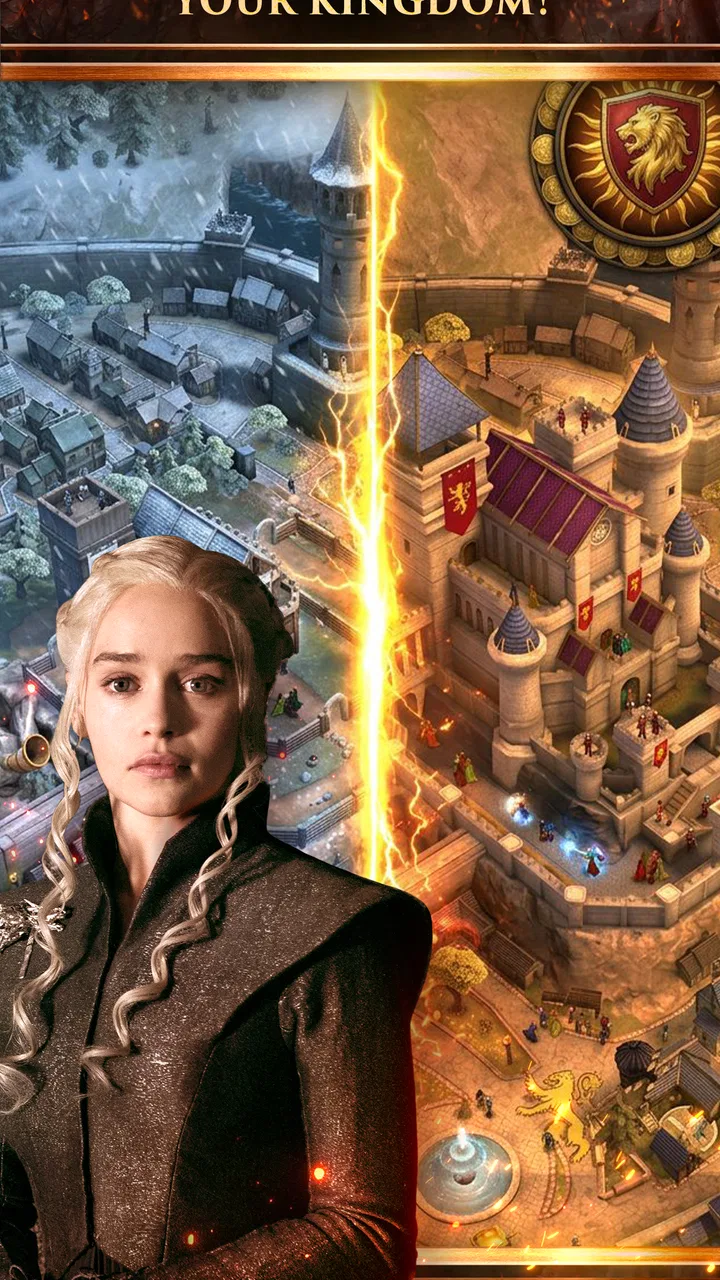
Game of Thrones: Conquest ™
- 4.3
- Rating
- 10.00M
- Installs
- Free
- Price

 Analysis by App-foxy
I came to Game of Thrones: Conquest ™ expecting a familiar mobile strategy game with a famous setting attached, but I found something more patient and political than a quick battle app. Developed by Warner Bros. International Enterprises, it puts me in the position of building influence, managing a growing stronghold, and choosing when to compete for power across Westeros. It is free to start, although optional purchases range from $0.99 to $99.99 per item, so the real question is not whether you can download it without paying, but whether its long-term pace suits the way you like to play.
The game has been available since October 17, 2017, and its audience is substantial: it has passed 10 million installs, with an average rating of 4.3 from around 325 thousand ratings and roughly 29 thousand written reviews. Those figures suggest a well-established community rather than a short-lived tie-in. I also noticed that the Teen content rating matters here. The presentation leans into conflict, ambition, and the harsher side of the Game of Thrones world, so this is not designed as a gentle city builder for very young players.
Where the real decisions begin
The first hours are easy to understand. I expand the base, improve buildings, gather what I need, and follow the guidance that introduces the main systems. That opening can feel generous because progress comes quickly and the game keeps presenting clear objectives. The more interesting decisions arrive when several upgrades compete for the same attention. Improving one part of the settlement may help future growth, while another choice may make the next stretch of play more comfortable immediately.
You May Also Like

 Blood Strike: 2.5 Anniversary
Blood Strike’s Loadouts Turn Every Drop Into a Tactical Gamble
A close look at Blood Strike’s custom loadouts: how fast access to signature weapons reshapes its battle royale rhythm, rewards preparation, and narrows the gap between fights.

 Pandora - Music & Podcasts
Pandora’s Music Is Easy to Start, but Harder to Recover
Pandora’s strength is its low-effort path from a seed to a station. Its weak spot is how much confidence it asks you to place in connection, setup, and quiet recovery.

 8 Ball Pool
 Is Built on Rivalries, Rematches, and Routine
A close look at the rivalries, rematches, shared routines, and unanswered safety questions that turn a quick pool match into a persistent mobile community.

 Samsung Music
’s Quiet Strength Is Playing What You Already Own
Its reach comes less from spectacle than from dependable access to a personal library. That simplicity is both the app’s strongest retention engine and its ceiling.

 AccuWeather: Weather Radar
AccuWeather Review: A Quick, Clear Forecast for Everyday Decisions
For everyday plans, the best forecast is the one you can understand quickly. AccuWeather makes rain timing, radar, and local conditions easy to act on, with a few trade-offs.

 Hill Climb Racing
Why Hill Climb Racing Still Turns Crashes Into One More Run
A tiny car, a bumpy hill and one more upgrade: Hill Climb Racing keeps resurfacing because its simple chaos makes every near-miss feel personal.
More From Our News Desk



That difference between short-term comfort and long-term readiness is the heart of the experience. I learned not to treat every available upgrade as equally urgent. A building that makes the base look more advanced is not automatically the best use of my current resources. Before committing, I ask what the improvement unlocks, whether it supports the type of army or development path I am pursuing, and how long I expect to remain active before returning to the game.
This is where the setting helps. Westeros is built around competing claims, fragile alliances, and decisions made before the consequences are visible. The game does not become a role-playing story simply because it uses that world. Instead, the familiar houses and locations give the strategic choices a stronger identity. I am not just upgrading anonymous buildings; I am trying to create a position that can survive pressure from other players and still have room to grow.
The most useful habit is to plan one step beyond the current objective. If a task asks me to improve a structure, I consider the resource demand of the next task before spending everything. That small pause prevents a common mistake: finishing one requirement and then being unable to take advantage of the new option it opens. The game rewards players who think in sequences rather than isolated taps.
Why planning horizons matter
Some sessions are active and hands-on, while others are mostly about setting up the next return. I might check the game during a short break, start an improvement, review what is available, and leave with a clear reason to come back later. This makes it a natural fit for players who enjoy ongoing progress rather than a complete match in a few minutes.
That rhythm also creates a trade-off. If I want immediate action every time I open the app, the waiting and preparation can feel slow. The game is more satisfying when I accept that not every session needs a battle or a major breakthrough. A useful everyday scenario is a commute or lunch break: I can inspect the base, make a careful upgrade choice, and prepare for a later session without needing to finish a full campaign before putting the phone away.
Players who prefer compact strategy games with a clear beginning and end may find this structure less appealing. A traditional board-game adaptation or a short tactical title usually gives more control over the length of a match. Here, progress is connected to a larger account and a continuing world, so the best decisions often matter because of what they prepare rather than what they accomplish instantly.
Risk, reward, and the cost of moving too quickly
The most tempting mistake is to spend resources as soon as they become available. Early progress makes that behavior feel correct, but later choices become more expensive in opportunity cost. When I use everything on one attractive improvement, I may delay research, troop preparation, or another development that would have made the overall position stronger. The game therefore asks me to distinguish between being busy and actually becoming safer or more capable.
There is also a psychological risk in the way free-to-play strategy games present progress. Optional purchases can reduce friction, speed up development, or help a player recover momentum. I appreciate having the option, but I would not recommend approaching the game with the assumption that spending is necessary for every obstacle. The better test is whether I still enjoy deciding what to prioritize when I ignore the shop. If the answer is no, purchasing more will probably not fix the underlying problem.
I found it useful to treat premium spending, if I choose it, as a limit rather than a solution. A small purchase may feel reasonable when it removes one specific bottleneck, but repeated convenience spending can change the way I make decisions. Instead of asking which upgrade gives the account the best future position, I start asking which delay I can pay to avoid. That is a less interesting strategic mindset and can make the game feel like a queue-management exercise.
Combat adds another layer of risk because preparation is not only about having more power. Timing, readiness, and the condition of the wider account matter. Acting simply because an opportunity appears can create a poor exchange if the result leaves me unable to respond to the next threat. I prefer to enter a conflict with a reserve rather than commit every available resource to one dramatic move.
How I protect progress
I keep a simple mental checklist before making an aggressive decision: what will this action cost, what do I gain if it works, and what can I still do if the outcome is disappointing? That third question is easy to overlook. A plan with no recovery path may look bold, but it makes one mistake disproportionately damaging.
Another practical approach is to separate development decisions from emotional reactions. If another player or event makes me feel pressured, I wait long enough to review the actual position instead of spending immediately. The Game of Thrones theme naturally encourages urgency and rivalry, but good strategy is often quieter. Sometimes the strongest move is to improve the base, preserve resources, and let a better opening appear later.
This makes the game more demanding than a simple power race, although it can also make losses feel personal. A player who enjoys rebuilding after a setback will find meaningful decisions here. Someone who wants every session to provide a clear victory may become frustrated, especially when progress depends on patience rather than a single clever action.
Adapting instead of following one permanent plan
I do not think there is one universally correct development path. The right choice depends on how often I play, how much time I can give the game, and whether I enjoy competition or mostly want to develop my own position. A highly active player can respond more often to changing circumstances. A more occasional player benefits from choices that remain useful even when the account is left alone for longer periods.
That distinction is important because the game can look similar on the surface while rewarding very different habits. If I log in frequently, I can make smaller adjustments and react to new opportunities. If I only check in occasionally, I need to avoid plans that depend on perfect timing. In my experience, the second style works better when I focus on dependable growth and avoid taking risks that require constant supervision.
Adaptation also means changing priorities when the current plan stops paying off. I may begin by concentrating on expansion, then realize that my position needs more preparation before I can compete effectively. Continuing with the original plan simply because I started it is a form of sunk-cost thinking. The game becomes more enjoyable when I treat each stage as information about what the account needs next.
Do not confuse a strong early lead with a complete strategy. Progress at the beginning can hide weaknesses that only become visible when demands increase. I try to review the balance between growth, readiness, and recovery after each major step. That review is especially valuable for new players who are tempted to copy the most visible path without understanding what it assumes about their available time.
The social side of the setting also affects adaptation. A game about seven kingdoms naturally frames success as a contest among competing powers, but I would not approach every interaction as a personal feud. Preserving flexibility is often more useful than chasing every possible confrontation. If I spend too much energy proving that I can win one exchange, I may lose the ability to respond elsewhere.
Who should play and who should skip it
I would recommend this game to fans of long-running mobile strategy, especially those who enjoy making choices that pay off over several sessions. It is a good match for someone who likes the Game of Thrones atmosphere but also wants a management layer rather than a purely narrative experience. Players who enjoy checking a developing base, comparing priorities, and adjusting plans will get more from it than players who only want fast tactical battles.
I would be more cautious recommending it to someone who dislikes timers, resource planning, competitive pressure, or optional purchases appearing around progression. The Teen rating is another reason to consider the audience carefully. The game’s conflict-focused world and mature tone are more appropriate for older players than for children looking for a simple fantasy builder.
It is also not my first choice for someone seeking a self-contained strategy experience. A console-style tactics game or a premium mobile title may offer more concentrated decision-making without the same ongoing progression structure. On the other hand, those alternatives usually do not provide the same persistent sense of building a position inside a recognizable political world.
Depth that becomes clearer over time
The game’s depth does not come from making every screen complicated. It comes from the way several modest choices interact. An upgrade changes what I can do next; that new option changes how I use resources; the resulting position affects whether I can take a risk. The individual actions are approachable, but the consequences become harder to judge as the account develops.
That gradual learning curve is one of the better parts of the design. I can begin without understanding every implication, then improve by noticing which decisions create problems later. The downside is that early mistakes may not reveal themselves immediately. A new player can feel successful while building habits that become inefficient once the demands rise.
For that reason, I recommend treating the opening period as a learning phase rather than a race. Pay attention to what each improvement enables, keep enough resources for the next meaningful step, and resist the urge to imitate advanced players without knowing how frequently they play. This approach makes the transition into deeper strategy less abrupt.
The current version is 26.2.822288, and the game supports devices running Android 7.0 or later. That makes it accessible to a fairly broad range of Android users, though the actual comfort of play will still depend on the phone’s age, screen size, and how smoothly it handles a persistent strategy game. I would check the device experience early, especially if I plan to spend a lot of time reviewing detailed menus and managing several decisions in one session.
One of the strongest long-term habits is keeping a reason for every major commitment. I do not need a perfect spreadsheet, but I do need to know whether I am investing for immediate defense, future growth, or a specific competitive opportunity. When I can explain the purpose of an action, I am less likely to waste resources simply because the button is available.
How it compares with familiar alternatives
Compared with a quick arena strategy game, Game of Thrones: Conquest ™ feels less focused on one isolated match and more concerned with the condition of an evolving account. The reward is continuity: decisions carry forward, and the base becomes a record of how I have played. The cost is that a poor decision can remain relevant longer, and progress does not always fit neatly into a short session.
Compared with a traditional city builder, it has a stronger competitive identity. I am not only arranging production or improving a settlement for its own sake; the wider theme encourages me to think about influence, rivalry, and preparedness. That makes the game more emotionally engaging, but also less relaxing when I want a purely decorative or low-pressure experience.
Compared with a premium strategy game, its free entry is convenient, but the continuing purchase structure requires more self-control. I can try the core experience without paying, yet I need to decide whether its pacing feels fair to me before considering optional spending. For my own use, that is the sensible order: play long enough to understand the rhythm, then decide whether the ongoing format fits my habits.
My strategy verdict after living with the game
Game of Thrones: Conquest ™ works best when I approach it as a long-term contest of priorities rather than a sequence of instant victories. Its strongest quality is the way it turns familiar political tension into practical decisions about timing, growth, preparation, and risk. I enjoy it most when I have a clear plan for the next few sessions and enough patience to let that plan develop.
Its limitations are equally clear. The persistent structure will not satisfy everyone, particularly players who want short, decisive matches or a strategy game without free-to-play pressure. Waiting, resource bottlenecks, and competitive uncertainty can make the experience feel demanding. Optional purchases between $0.99 and $99.99 per item also mean that I would set a personal spending boundary before becoming deeply invested.
Still, the combination of a recognizable world, accessible opening, and increasingly meaningful planning gives it a reason to stay installed. I would suggest trying it free first, paying attention to whether you enjoy the pauses between decisions as much as the decisions themselves. If you like building an advantage gradually, adapting when circumstances change, and thinking about what today’s choice means several sessions from now, this is a compelling strategy game to explore.
My final recommendation is therefore selective but positive: choose it for persistent progression, political atmosphere, and layered planning, not for instant action. When I play with realistic expectations, preserve resources, and treat every upgrade as part of a larger plan, the game feels much richer than its simple opening suggests. When I rush, chase every opportunity, or spend just to remove frustration, much of that strategic appeal disappears.
FAQs for Game of Thrones: Conquest ™
01What is the main objective of Game of Thrones: Conquest™?
In Game of Thrones: Conquest™, the main objective is to build your house, grow your army, and conquer the Seven Kingdoms. Players must strategize to form alliances with other players and engage in battles to expand their influence. The game captures the political intrigue and warfare that fans of the series love.
02Are there in-app purchases in Game of Thrones: Conquest™?
Yes, Game of Thrones: Conquest™ includes in-app purchases. Players can buy resources, speed up processes, and acquire exclusive items to enhance their gameplay experience. While the game is free to play, these purchases can provide advantages in building your empire and advancing more quickly.
03Is Game of Thrones: Conquest™ suitable for all ages?
Game of Thrones: Conquest™ is rated for ages 17 and up due to its themes of violence and mature content, consistent with the TV series. Parents should be aware of the game’s content and decide if it’s appropriate for younger players. The game involves strategic battles and political maneuvering.
04Can I play Game of Thrones: Conquest™ without an internet connection?
No, Game of Thrones: Conquest™ requires a stable internet connection to play. The game is online-based, relying on real-time interactions with other players, forming alliances, and participating in events. An active connection ensures you can engage fully with the dynamic, multiplayer world.
05What platforms support Game of Thrones: Conquest™?
Game of Thrones: Conquest™ is available on both Android and iOS platforms. Players can download it from the Google Play Store or the Apple App Store. Ensure your device meets the necessary system requirements for optimal performance and compatibility with the game.
Pros
- Immersive world-building experience.
- Strategic gameplay with alliances.
- Frequent updates with new content.
- Rich storyline from the GoT universe.
- Visually stunning graphics.
Cons
- Requires constant internet connection.
- Freemium model can be costly.
- High battery consumption.
- Complex for new players.
- Long build and upgrade times.

Game of Thrones: Conquest ™
Gallery